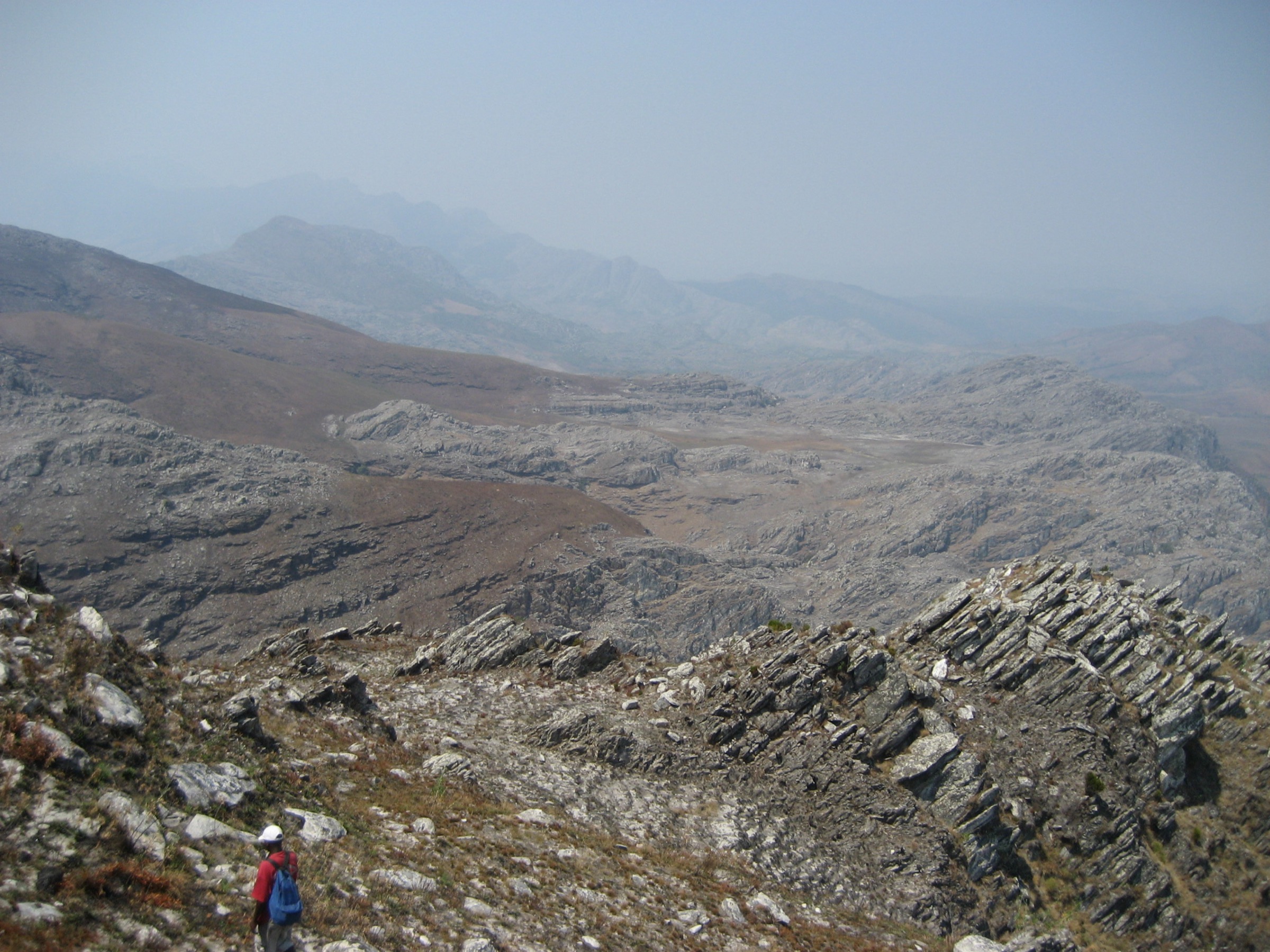
Regional overview
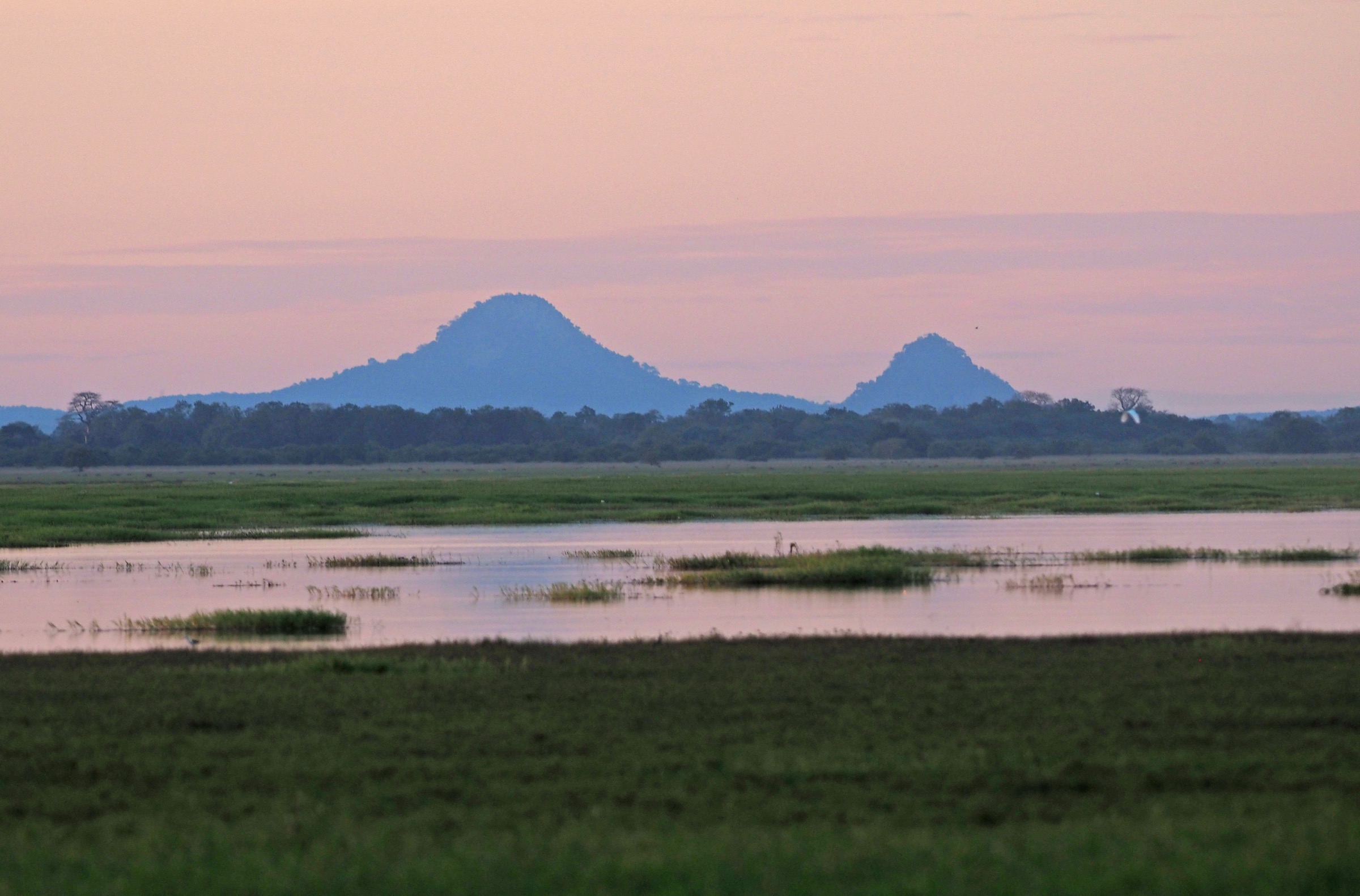
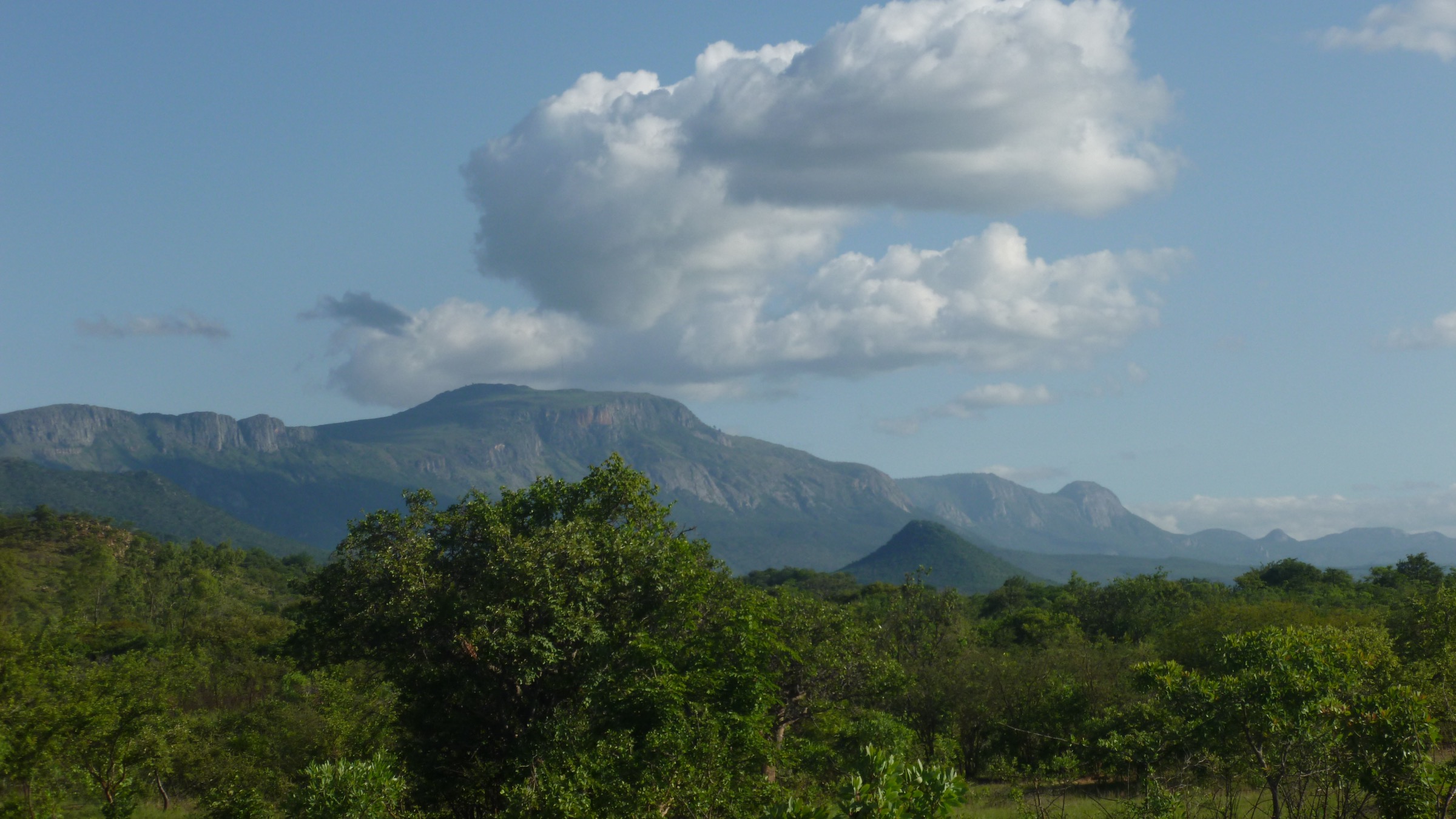
The Chimanimani Mountains form the southernmost block of the Eastern Highlands, straddling the border between Manicaland Province in Zimbabwe and Manica Province in Mozambique. The range is a heavily folded quartzite massif: jagged ridges, deep gorges and a high inner plateau drained by the Bundi River, with peaks rising from a central tableland at roughly 1,500–1,800 m to Monte Binga (2,436 m, Mozambique’s highest summit) and Kweza/Peza (~2,394 m). The Zimbabwe side is protected as Chimanimani National Park (171 km²), managed by ZimParks, and the Mozambique side is protected as Chimanimani National Park (about 656 km², upgraded from a National Reserve in 2020), managed by Mozambique’s National Administration of Conservation Areas (ANAC) with conservation support from the Micaia Foundation and other partners. Together they form the Chimanimani Transfrontier Conservation Area.
Almost all walking on the Zimbabwe side is wilderness hiking. There are no internal roads inside the park: the Mutekeswane Base Camp (~1,250 m), reached by gravel road from Chimanimani village, is the single trailhead, and every route then climbs through forested kloofs onto the plateau, where the Mountain Hut (about 1,630 m, beside the upper Bundi River) functions as the only roofed shelter. The Mozambique side is more remote: the main park gate is reached from Sussundenga via the EN6 and a long dirt track, with a basic visitor camp on the Mussapa Pequena River and community guides organised through ANAC/Eco-Micaia. Mt Binga is approached from either side but is most often climbed from the Zimbabwe Mountain Hut. The plateau also has historical significance — the Skeleton Pass route was used during the Rhodesian Bush War and the Mozambican civil conflict to move people and supplies across the border.
The best hiking season is the cool dry months from May to early September, when the plateau is open, streams are clear and visibility is at its best. October to November is hot and prone to thunderstorms; December to March is the wet season with frequent low cloud, slippery rock slabs, fast-rising streams and a real risk of being trapped on the plateau. Mist can blanket the inner plateau within minutes at any time of year, and navigation off the marked routes is genuinely difficult — the quartzite outcrops all look similar and the cairned paths are intermittent. Water on the plateau is generally drinkable after filtering or treatment.
Cyclone Idai struck the Chimanimani District in March 2019, causing catastrophic landslides on both flanks of the range, killing hundreds of residents and damaging access roads, footbridges and trails. The Mountain Hut survived but the approach paths, especially Bailey’s Folly, the Hadange/Outward Bound route and the Mozambique-side tracks were severely affected, and parts of the gravel road from Chimanimani village to Mutekeswane were rebuilt only slowly. Trail conditions, river crossings and the Hadange suspension bridge should be verified locally before any trip; the park has been progressively re-opened but specific routes can still be closed or rerouted after heavy rain.
Selection rationale
The five hikes below cover the iconic Mozambique-border summit, the classic forest-route into the plateau, the historically charged border pass, a plateau valley walk to a waterfall, and an accessible forest/pool walk from the Outward Bound side. They include both Zimbabwe and Mozambique sides as requested. Two of them (Mt Binga and Digby’s Falls) are normally done as a day-section of an overnighting trip from the Mountain Hut and are framed as such — the Chimanimani has very few true day-from-the-road hikes that reach its core, so this framing is unavoidable for an honest catalogue of “essentials”. The Tessa’s Pool / Pork Pie Hill walk gives a genuine short day option for visitors not staying inside the park.
Summary table
| # | Hike | Country | Route type | Distance | Gain | Max elevation | Difficulty |
|---|---|---|---|---|---|---|---|
| 1 | Bailey’s Folly to the Mountain Hut | Zimbabwe | Out-and-back | 5–7 km one way | ~600 m | ~1,720 m | Moderate-strenuous |
| 2 | Mt Binga from the Mountain Hut | Zimbabwe / Mozambique border | Out-and-back (day section of overnight trip) | 10–15 km return | 800–1,000 m | 2,436 m | Strenuous |
| 3 | Skeleton Pass and Bundi Plain loop | Zimbabwe / Mozambique border | Loop (day section of overnight trip) | 8–10 km | 250–400 m above hut | ~1,910 m | Moderate |
| 4 | Southern Lakes and Digby’s Falls | Zimbabwe | Out-and-back (day section of overnight trip) | 6–9 km return | 150–250 m | ~1,750 m | Moderate |
| 5 | Tessa’s Pool and Pork Pie viewpoint | Zimbabwe | Out-and-back / loop | 4–8 km | 200–500 m | ~1,500–1,987 m | Easy-moderate |
1. Bailey’s Folly to the Mountain Hut

Snapshot
Itinerary
The route leaves Mutekeswane Base Camp, where visitors register and pay park fees, and follows a clearly graded path through msasa woodland onto the lower slopes. After about 20–30 minutes a junction offers either the longer, more gradual Banana Grove track or the shorter, steeper Bailey’s Folly. Bailey’s Folly climbs directly through rocky steps and a band of montane forest, gaining height quickly along a quartzite spur with intermittent views back down the Mutekeswane valley. The trail tops out on a small col, then drops gently westward into the headwaters of the Bundi River, reaching the Mountain Hut on the west bank of the river at about 1,630 m. The hut is unfurnished and shared, with basic ablutions. Return is by the same route, or via the gentler Banana Grove path for a partial loop.
Why it is essential
Bailey’s Folly is the standard gateway to the entire Chimanimani plateau and the only way many visitors will see the Bundi valley in a single day. Almost every other classic Chimanimani route starts from the hut, and the climb itself, through forest into open quartzite country with views of the Dragon’s Tooth pinnacles, is a representative cross-section of the range.
Equipment
Mountain hiking equipment: sturdy boots with grip for wet rock, weatherproof layer, warm layer, water (1.5–2 L per person; refill possible at the hut), food, headtorch in case of late descent, map/GPS. ZimParks entry fee payable at Mutekeswane.
Hazards and notes
Rock steps on Bailey’s Folly become slippery after rain. Afternoon thunderstorms are common in summer and the upper section is exposed. Navigation in mist between the col and the hut is non-trivial; cairns are intermittent. The Mountain Hut cannot be booked exclusively and is communal. Post-Cyclone Idai (March 2019), parts of the path have been re-cut and the gravel road from Chimanimani village to Mutekeswane was rebuilt only slowly; check current conditions with ZimParks at Mutekeswane before departure.
Routes and maps
| Source | URL | Format | Reuse status |
|---|---|---|---|
| Wikiloc — Chimanimani, Manicaland (community-uploaded; Bailey’s Folly is the standard ascent leg) | wikiloc.com | GPX (per-track; download requires account) | Wikiloc terms; per-track licences vary; coordinates may be reused if redrawn |
| Hiiker — Base Camp - The Hut - Skeleton Pass | hiiker.app | Trail page with stats | Hiiker terms; reference only |
| OpenStreetMap — paths within Chimanimani National Park | openstreetmap.org | OSM data | ODbL 1.0; reusable with attribution |
No official ZimParks GPX could be located.
Further reading
- zimparks.org — ZimParks: Chimanimani
- zimfieldguide.com — Zimbabwe Field Guide: Chimanimani National Park
- wholeeartheducation.com — Whole Earth Education: Chimanimani Mountains
- indefinitedetour.com — Indefinite Detour: Hiking in the Chimanimani Mountains
- tracks4africa.co.za — Tracks4Africa: Mutekeswane Base Camp
2. Mt Binga from the Mountain Hut

Snapshot
Itinerary
From the Mountain Hut the path crosses the upper Bundi and then climbs south-east across rolling grassland and quartzite slabs, joining the line towards the col between Dombe and Binga. From the broad shoulder the cairned trail swings north-east beneath the western flank of Binga, then south-east again, scrambling up the western face to gain the summit ridge. A short rocky scramble leads to the beacon at the top, marked with cairns. Allow about 3 hours from the Bundi valley up, with a similar time back. The summit gives a 360° panorama: the entire Chimanimani plateau to the north, the Bundi gorges below, the wooded escarpment dropping into Mozambique to the east, and on clear days a long view across the Manica lowlands. Although the summit straddles the border, most parties start and finish on the Zimbabwe side. A longer, expedition-style ascent from the Mozambique gate via Maciene and the Mussapa Pequena valley exists but normally requires two nights and a local guide arranged through ANAC/Eco-Micaia.
Why it is essential
Mt Binga is the highest point in Mozambique and the second-highest in Zimbabwe, the natural high point of the Eastern Highlands, and the only way for a fit hiker to see both halves of the transfrontier range in one panorama. It is the iconic summit of the region.
Equipment
Mountain hiking equipment: sturdy boots, full waterproofs, warm layer, hat and gloves outside midsummer, 2–3 L water (limited reliable water above the hut), food, map/GPS with backup, headtorch. Hut booking at Mutekeswane.
Hazards and notes
The ridge is exposed to wind and lightning; afternoon storms develop quickly in summer and an early start is essential. The summit cairn is hard to find in mist. Routes are not waymarked above the Bundi crossings and rely on cairns. A 1980s-era warning about old landmines near Skeleton Pass is sometimes referenced — incidents are reported as historical, but parties should stay on established paths. Border-crossing: standing on the summit cairn straddles the international border, which is permissible, but descent into Mozambique is not, without entry through an official border post. The Mozambique-side approach tracks were severely affected by Cyclone Idai (March 2019); the Mozambique-side ascent in particular should be confirmed locally.
Routes and maps
| Source | URL | Format | Reuse status |
|---|---|---|---|
| Wikiloc — Mount Binga via the Hut, Digby’s Falls and Paradise Pool | wikiloc.com | GPX (per-track) | Wikiloc terms; per-track licence; coordinates may be reused if redrawn |
| Wikiloc — Mozambique–Zimbabwe Mount Binga, 2463 m | wikiloc.com | GPX | Wikiloc terms; reference only |
| Wikiloc — Monte Binga Chimanimani | wikiloc.com | GPX | Wikiloc terms; reference only |
Further reading
- summitpost.org — SummitPost: Mount Binga
- en.wikipedia.org — Wikipedia: Monte Binga
- anac.gov.mz — ANAC: Chimanimani
- countryhighpoints.com — Country Highpoints: Mozambique, Mt Binga
- mozambiqueexpert.com — Mozambique Expert: Monte Binga
3. Skeleton Pass and Bundi Plain loop

Snapshot
Itinerary
From the Mountain Hut, the path follows the Bundi River north along the plateau, passing tannin-coloured pools and clusters of protea and erica. After about an hour the route swings east, climbing gradually across grassy slopes and quartzite slabs to the saddle of Skeleton Pass (~1,910 m), which marks the international border ridge. The pass gives long views east into the wooded Mozambique-side gorges of the Mussapa system. Most day parties return on the same line; an alternative loop drops west into the upper Bundi valley and rejoins the river path back to the hut, optionally taking in a side-trip towards the Banti viewpoint and the rim above the Mozambique escarpment.
Why it is essential
Skeleton Pass is the historical cross-border route between Zimbabwe and Mozambique, used by smugglers, missionaries and, during the Rhodesian Bush War and Mozambican civil war, by combatants moving between the two countries. The pass and the Bundi Plain together are the cultural and scenic heart of the range, and the loop is the most representative “plateau day” possible from the hut.
Equipment
Mountain hiking equipment as for Hike 1, plus extra water (some plateau pools are stagnant in late dry season; the Bundi itself is generally good), map/GPS, navigation backup for mist.
Hazards and notes
Although on the inner plateau, the route is exposed to wind, sudden mist and lightning. Old landmine warnings near Skeleton Pass refer to a single pre-1990 incident and the area is now considered safe on established paths, but visitors should stay on the cairned route. Descending into Mozambique without an official border crossing is not permitted. Plateau cairns are sometimes washed out after the rains. Cyclone Idai (March 2019) damaged the Mozambique-side tracks below the pass, so any descent or extended loop towards the Mussapa system should be checked locally before being attempted.
Routes and maps
| Source | URL | Format | Reuse status |
|---|---|---|---|
| Hiiker — Base Camp - The Hut - Skeleton Pass | hiiker.app | Page with stats | Hiiker terms; reference only |
| Wikiloc — Chimanimani hikes (parent listing) | wikiloc.com | GPX (per-track) | Wikiloc terms; coordinates may be reused if redrawn |
| OpenStreetMap — Bundi plateau | openstreetmap.org | OSM data | ODbL 1.0; reusable with attribution |
Further reading
- wholeeartheducation.com — Whole Earth Education: Chimanimani Mountains
- zimfieldguide.com — Zimbabwe Field Guide: Chimanimani National Park
- travel-info.co.zw — Travel-info: Chimanimani Mountains and National Park
- summitpost.org — SummitPost: Descending Skeleton Pass
4. Southern Lakes and Digby’s Falls
Snapshot
Itinerary
From the Mountain Hut the route follows the Bundi upstream onto the open Southern Lakes section of the plateau, where the river meanders through a complex of shallow tarns and dark-coloured pools fringed with proteaceous shrubs. After about 30–40 minutes a clear branch leads southeast to Digby’s Falls, where the Bundi tumbles down a stepped quartzite cleft into a large deep pool. The path descends rough rock steps to the foot of the falls; experienced hikers sometimes continue to Paradise Pool a short distance downstream. The return reverses the route along the river. The walk is rarely cited with strict distance figures; sources consistently describe the falls as around 40 minutes’ walk from the hut, with the Southern Lakes loop adding another 1–2 hours.
Why it is essential
The Southern Lakes / Digby’s Falls walk is the classic plateau “rest day” route and shows the upper Bundi at its most characteristic: the broad, sponge-like wetland of dark pools that gives the Chimanimani its unmistakable hydrological character. Digby’s Falls is the most accessible major waterfall on the plateau and a recognised plateau landmark.
Equipment
Mountain hiking equipment; swimwear if pools are to be used; rock-grip footwear for the descent to the falls; water filter or treatment.
Hazards and notes
The rock at the falls is extremely slippery when wet; the descent is the most hazardous section. Cold mountain water — extended swimming is not advised. Plateau navigation between the Southern Lakes and the hut becomes difficult in mist. Trail conditions after Cyclone Idai (March 2019) have shifted some of the lower pool approaches; check at the hut.
Routes and maps
| Source | URL | Format | Reuse status |
|---|---|---|---|
| Wikiloc — Mt Binga via the Hut, Digby’s Falls and Paradise Pool (includes the Southern Lakes / falls leg) | wikiloc.com | GPX (per-track) | Wikiloc terms; per-track licence; coordinates may be reused if redrawn |
| OpenStreetMap — Southern Lakes / upper Bundi | openstreetmap.org | OSM data | ODbL 1.0; reusable with attribution |
No verified standalone public GPX could be located for the Southern Lakes / Digby’s Falls leg; it appears only as part of the longer Mt Binga track.
Further reading
- wholeeartheducation.com — Whole Earth Education: Chimanimani Mountains
- travel-info.co.zw — Travel-info: Chimanimani Mountains and National Park
- zimfieldguide.com — Zimbabwe Field Guide: Chimanimani National Park
- indefinitedetour.com — Indefinite Detour: Hiking in the Chimanimani Mountains
5. Tessa’s Pool and Pork Pie viewpoint

Snapshot
Itinerary
From the Outward Bound School car park, a marked path drops to the Hadange River, which is crossed on a narrow wooden suspension bridge — one of the original entry routes into the Chimanimani Mountains. The trail then climbs along the Hadange gorge through montane forest of Uapaca and palms, reaching a series of cascades that culminate at Tessa’s Pool: a 30 m waterfall plunging into a circular pool below. Upper pools can be reached by clambering through the gorge above. From the Outward Bound area, Pork Pie Hill (1,987 m) is most often accessed by 4WD on a rough track, with a short walk to the summit beacon and an open 360° view over Chimanimani village, the Eland Sanctuary and the main range to the south-east. Fit walkers occasionally ascend Pork Pie on foot.
Why it is essential
Tessa’s Pool and the Hadange gorge are the classic short-walk introduction to the Chimanimani for visitors who are not heading into the plateau, and the Outward Bound School itself is an integral piece of the area’s modern hiking history. Pork Pie Hill, despite being driven, offers the single best low-altitude panorama of the range and the foothills, and pairing the two gives a balanced half-day for visitors based in Chimanimani village.
Equipment
Standard hiking equipment: shoes with good wet-rock grip, sun protection, swimwear, water. Permission from Outward Bound (and a small fee) is required to enter the pool area.
Hazards and notes
The cascade rock is dangerously slippery; the upper pools require easy scrambling and have been the site of accidents. Pork Pie’s track is steep, rocky and 4WD-only. Cyclone Idai (March 2019) damaged the Hadange suspension bridge and parts of the access road north of Chimanimani village; verify locally that the bridge and access are open before setting out. Outward Bound is an active youth-camp facility — visitors should check in at the office before walking on the property.
Routes and maps
| Source | URL | Format | Reuse status |
|---|---|---|---|
| Wikiloc — Tessa’s Pool, Chimanimani | wikiloc.com | GPX (per-track) | Wikiloc terms; per-track licence; coordinates may be reused if redrawn |
| Wikimapia — Hadange Trail | wikimapia.org | Map page | Wikimapia terms; reference only |
| OpenStreetMap — Outward Bound / Hadange area | openstreetmap.org | OSM data | ODbL 1.0; reusable with attribution |
Further reading
- chimanimani.com — Chimanimani.com: Tessa’s Pool
- lonelyplanet.com — Lonely Planet: Tessa’s Pool
- zimbabweflora.co.zw — Flora of Zimbabwe: Outward Bound / Tessa’s Pool location record
- tracks4africa.co.za — Tracks4Africa: Tessa’s Pool
- wikimapia.org — Wikimapia: Hadange Trail
Notes and caveats
- Official ZimParks and ANAC trail maps with formal distance/gain figures could not be retrieved; statistics are triangulated from secondary trip reports and Wikiloc tracks and should be tightened against an official park brochure where possible.
- No verified GPX file was located specifically for the Southern Lakes / Digby’s Falls leg as a standalone route (it appears only as part of the longer Mt Binga track on Wikiloc).
- No licence-compatible images were located for Tessa’s Pool itself, Bailey’s Folly path, the Mountain Hut interior/exterior, Digby’s Falls, or the Mozambique-side base camp at Maciene / Mussapa Pequena. A targeted Flickr CC search and outreach to local conservation NGOs (Micaia, ZimParks) is recommended.
- Post-Cyclone Idai (March 2019) trail and bridge status — particularly on Bailey’s Folly, the Hadange suspension bridge, the access road from Chimanimani village to Mutekeswane, and the Mussapa-side approaches on the Mozambique side — needs local confirmation immediately before any visit; trail rehabilitation has been described as gradual and conditions can shift after each rainy season.
- The Mozambique-side Mt Binga route from Maciene / Mussapa Pequena base camp is included only by reference, since it is rarely completed in one day. A separate Mozambique-only entry could be developed with ANAC and Eco-Micaia confirmation, and would need a guide-fee structure verified.
- Border-crossing rules on the summit ridge (Skeleton Pass, Mt Binga) should be cross-checked with ZimParks and ANAC; current practice is summit-only, no descent into the neighbouring country without an official border post.
- The “old landmine near Skeleton Pass” reference is a single pre-1990 historical incident widely repeated in secondary sources; current de-mining status should be confirmed with ZimParks.
Further reading
| Source | URL |
|---|---|
| ZimParks — Chimanimani National Park | zimparks.org |
| ANAC (Mozambique) — Chimanimani | anac.gov.mz |
| TFCA Portal — Chimanimani Transfrontier Conservation Area | tfcaportal.org |
| Micaia Foundation — Enterprises (Ndzou Camp etc.) | micaia.org |
| BirdLife Zimbabwe — Chimanimani Mountains IBA | birdlifezimbabwe.org |
| Key Biodiversity Areas — Chimanimani Mountains | keybiodiversityareas.org |
| Wikipedia — Chimanimani Mountains | en.wikipedia.org |
| Wikipedia — Monte Binga | en.wikipedia.org |
| Wikipedia — Chimanimani National Park (Mozambique) | en.wikipedia.org |
| SummitPost — Mount Binga | summitpost.org |
| SummitPost — Descending Skeleton Pass | summitpost.org |
| Hiiker — Base Camp - The Hut - Skeleton Pass | hiiker.app |
| Wikiloc — Chimanimani trails listing | wikiloc.com |
| Tracks4Africa — Chimanimani National Park | tracks4africa.co.za |
| Whole Earth Education — Chimanimani Mountains | wholeeartheducation.com |
| Zimbabwe Field Guide — Chimanimani National Park | zimfieldguide.com |
| Mozambique Expert — Chimanimani National Park | mozambiqueexpert.com |
| AGU Landslide Blog — NASA images of the Chimanimani landslides (Cyclone Idai) | blogs.agu.org |
| Wikimedia Commons — Category: Chimanimani Mountains | commons.wikimedia.org |