Regional overview
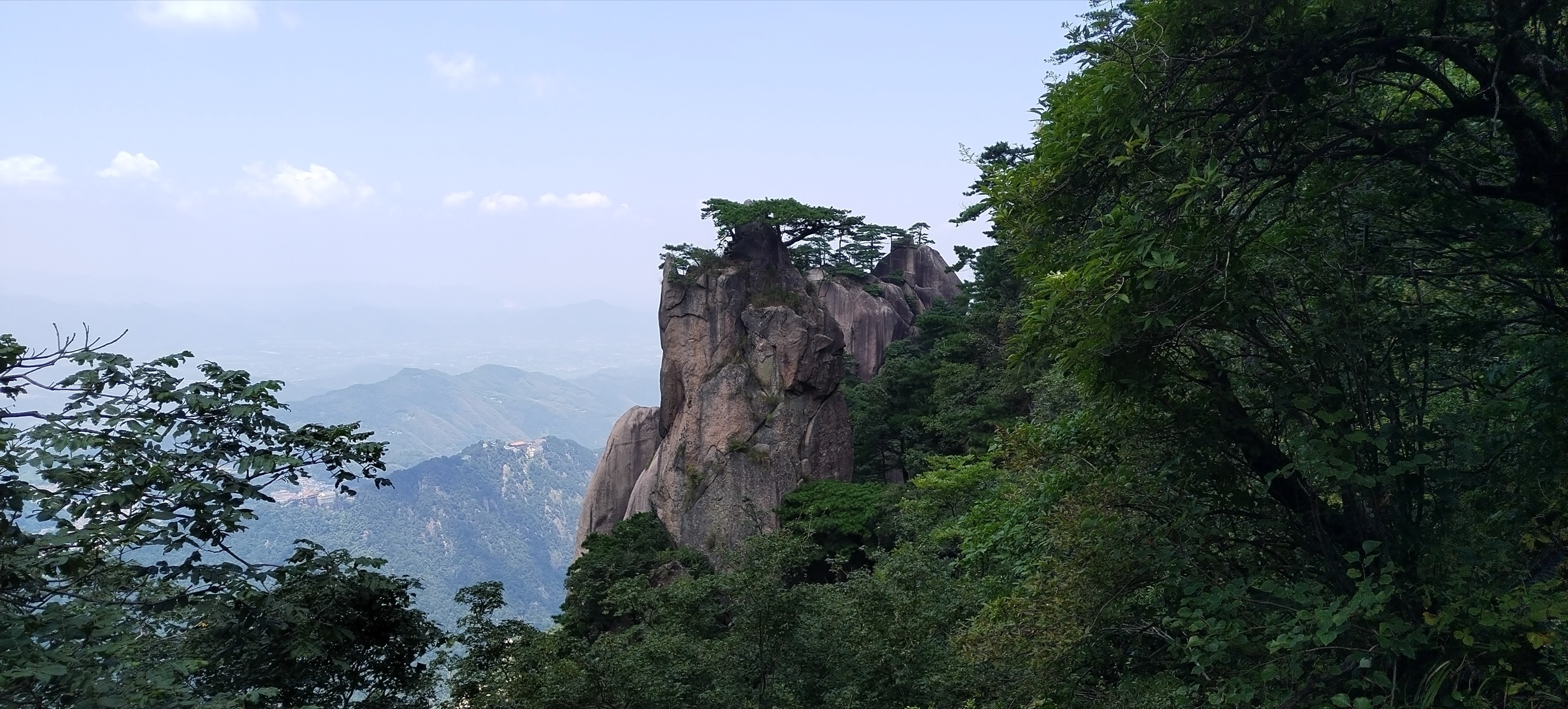
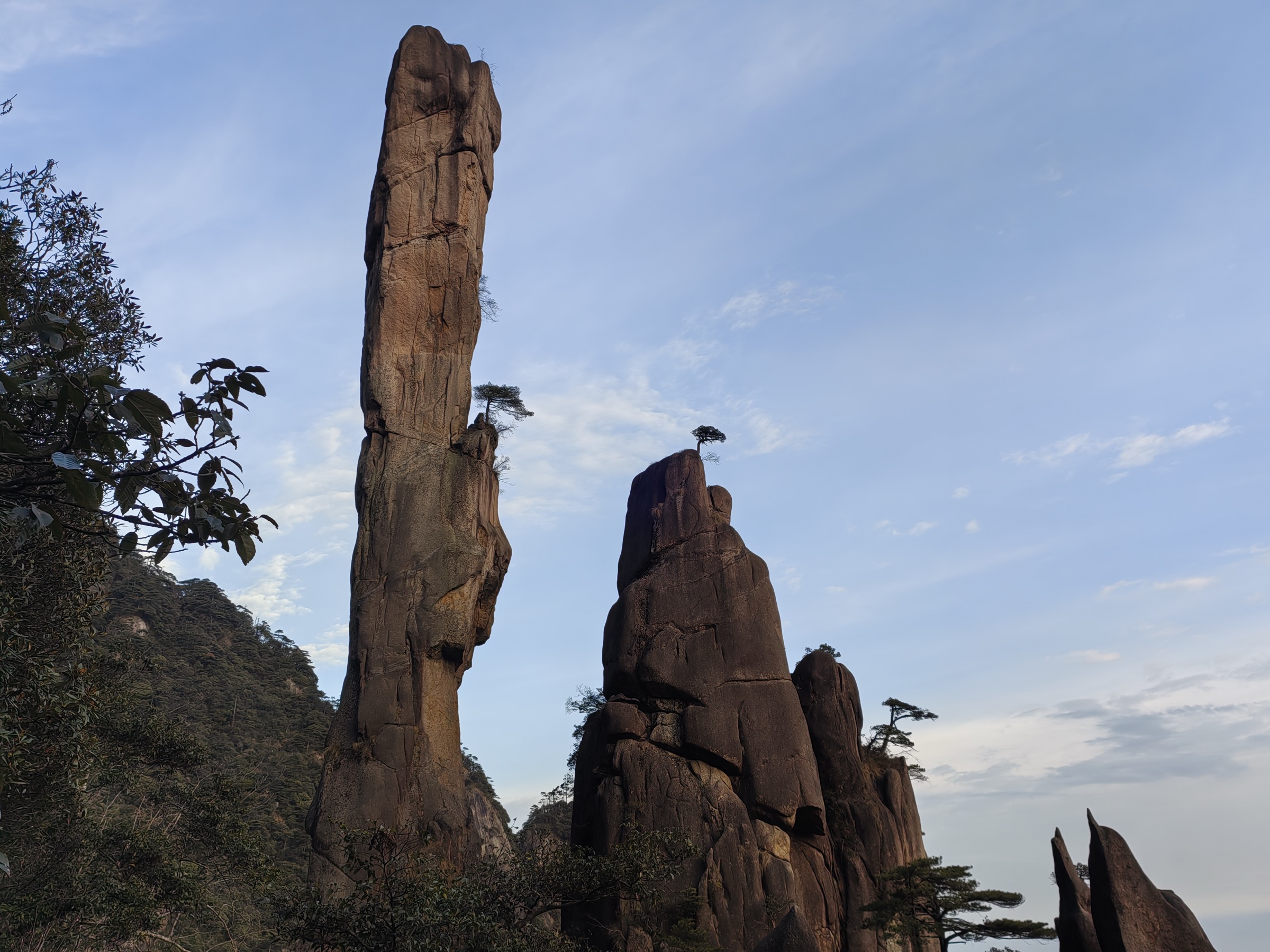
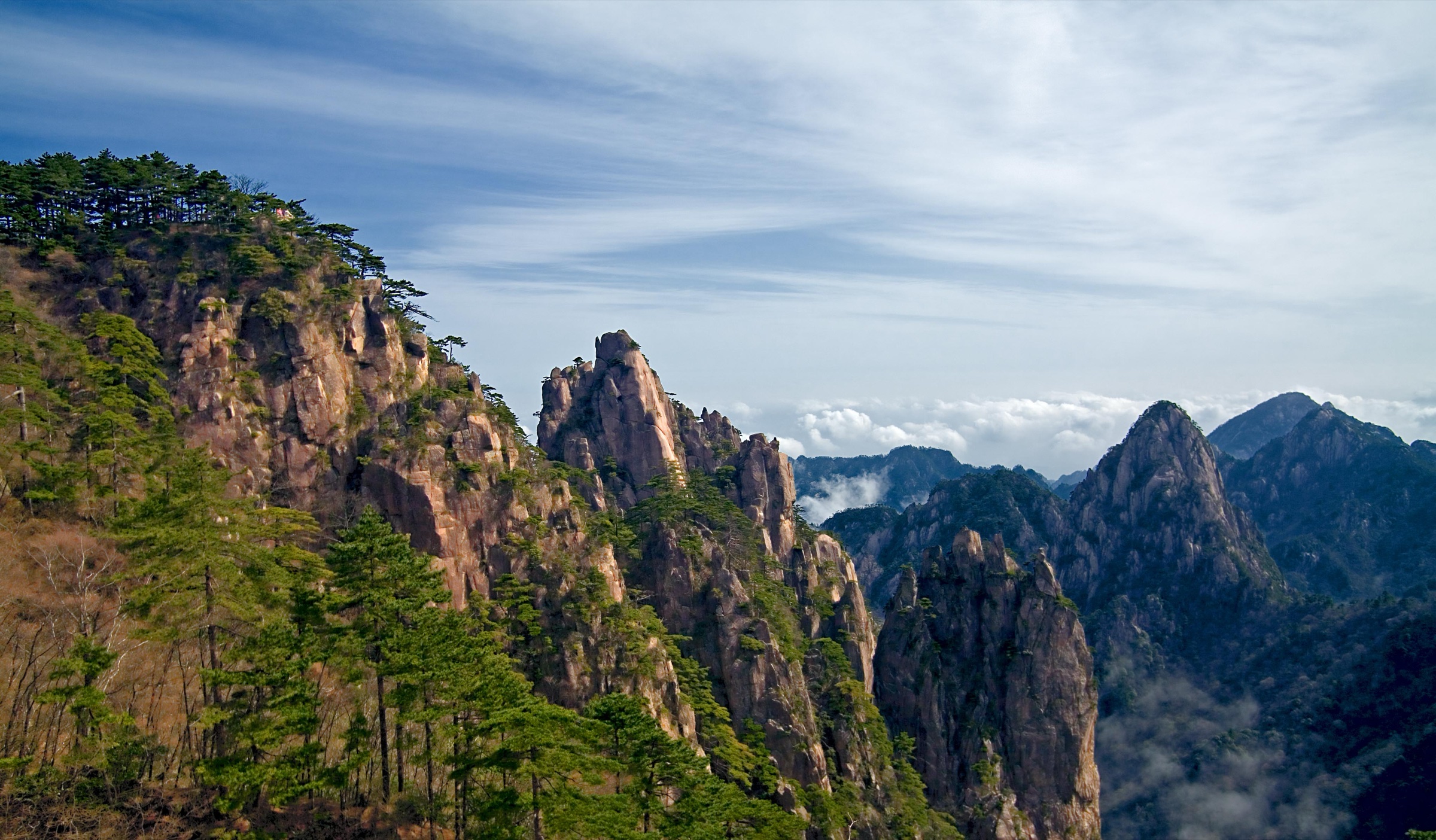
Mount Huangshan (黄山) is the granite-and-pine core of southern Anhui — a UNESCO World Heritage and UNESCO Global Geopark property of 77 named peaks above 1,000 m, with Lotus Peak (莲花峰, 1,864 m) the high point and Bright Summit (光明顶, 1,860 m) and Tiandu Peak / Celestial Capital Peak (天都峰, c. 1,810 m) the other two of the “three main peaks”. The geological story is unusually clean: a Yanshanian-period granite pluton lifted, fractured along vertical joints and weathered into spires, slabs, balanced boulders and the famous gnarled Huangshan pines (Pinus hwangshanensis) that take root directly in the rock. The result is a compact mountain that you walk almost entirely on engineered stone steps and cliff paths — there is no off-trail hiking inside the scenic area, and the day-walking grammar is closer to via-ferrata-by-stair than open tramping.
The walking ecosystem is built around the Mount Huangshan Scenic Area (黄山风景区). Access is funnelled through Tangkou at the southern foot, with the Yungu (云谷) cableway on the east, the Yuping (玉屏) cableway on the south and the Taiping (太平) cableway on the north feeding the high path network. Private cars stop at the Mt Huangshan Scenic Area transfer centre; from there a mandatory scenic-area shuttle bus runs to each cableway base. A combined entry ticket covers the scenic area; cableways and the in-canyon West Sea Grand Canyon funicular (西海大峡谷地轨缆车) are priced separately. Several key sections — Tiandu Peak, Lotus Peak and parts of the West Sea Grand Canyon — operate on rotating multi-year ecological closures, alternating open status with rest periods of several years. Same-day weather, snow/ice and maintenance closures are common in winter. Always confirm on the day.
The hiking character has three planning issues that dominate every Huangshan day. First, stair load: even short routes carry several hundred metres of vertical on stone steps, and the West Sea Grand Canyon and Tiandu Peak each add another long stair stretch on exposed cliff lines. Second, weather and visibility: the famous cloud-sea is just as often a blanketing fog — early morning and late afternoon are the most reliable view windows, and afternoon thunderstorms are routine in summer. Third, crowding and ticketing: the scenic area is one of China’s most heavily visited national landscapes, and stair queues at chokepoints (Tiandu’s “fish-back ridge”, the canyon stair below Paiyun Pavilion) can dominate the day’s pace during national holiday weeks; outside Golden Week and Spring Festival the mountain remains busy but moves freely.
Beyond Huangshan proper, the same regional ticket and cultural circuit normally bundles Qiyun Mountain (齐云山, 585 m) — the Taoist Danxia-sandstone counterpart west of Huangshan city in Xiuning County. It is included here as the catalogue’s lower-altitude cultural walk, complementing the granite ridges. For neighbouring sub-regions on the same eastern-China watershed, see Tianmu Shan, Zhejiang, Yandang Shan, southern Zhejiang and Sanqing Shan, Jiangxi.
Access is via Huangshan Tunxi International Airport (TXN), Huangshan North (黄山北) on the Hangzhou–Huangshan and Hefei–Huangshan HSR lines, and long-distance buses to Tangkou. From Huangshan North, scheduled buses and tourist shuttles reach the scenic-area transfer centre in roughly 60–90 minutes.
Selection rationale
Five day-hikes are presented across the Huangshan region: the Yungu–Ciguang traverse as the full cross-mountain benchmark, the West Sea Grand Canyon as the cliff-canyon objective, Tiandu Peak via Yuping as the steep exposed summit, the Flying Rock and Bright Summit high loop as the compact summit-zone day, and the Qiyun Mountain Taoist cliff-temple loop as the lower Danxia counterpart. The set is built around access cableway and route character: a long traverse, a canyon descent-and-ascent, a summit spur, a short high loop, and a culturally different lower walk.
Routes that sit primarily outside a day-hike frame — the multi-day Huangshan summit-hotel circuits, the back-country traverses west of Bright Summit, and the longer Huizhou ancient-road through-trips — are excluded.
Summary
| # | Hike | Trailhead | Route type | Distance | Gain | Time | Difficulty |
|---|---|---|---|---|---|---|---|
| 1 | Yungu Temple to Ciguang Pavilion traverse | Yungu cableway base | Point-to-point | 15.4 km | 1,463 m | 7.5–8.5 h | Hard |
| 2 | West Sea Grand Canyon | Paiyun Pavilion | Point-to-point + variants | 2.1 km core | 55 m core | 1–1.5 h core | Moderate–Hard in full form |
| 3 | Tiandu Peak via Yuping | Yuping cableway upper station | Point-to-point | 8.4 km | 983 m | 4.75–5.5 h | Hard |
| 4 | Flying Rock and Bright Summit loop | Bright Summit area | Loop | 3.2 km | 240 m | 1.5–2 h | Moderate |
| 5 | Qiyun Mountain cliff-temple loop | Qiyun scenic-area entrance | Loop / out-and-back | 5–8 km | 300–500 m | 3–5 h | Moderate |
1. Yungu Temple to Ciguang Pavilion traverse

Snapshot
Itinerary
From the Yungu cableway base, climb the engineered stone path into the Beihai (北海) summit-viewpoint zone, linking the pine-and-granite viewpoints with the high central ridge. Continue across the main scenic heart — past Bright Summit (光明顶), the Flying Rock (飞来石) lookout, the West Sea entrance and the Yuping Pavilion (玉屏楼) with its Guest-Greeting Pine (迎客松) — and descend the long Yuping–Ciguang stair to the Ciguang Pavilion at the bottom. Walking the cableway lines on foot is permitted but adds time and stair load; most parties walk the traverse and use the scenic-area shuttle either side.
Why it is essential
This is the full Huangshan benchmark: the only single-day way to cross the UNESCO property on foot, taking in pines, cloud-sea viewpoints, cliff paths and the main-peak architecture in one push. Most Huangshan visitors see a fraction of the mountain on cableway-stub circuits; this route puts the whole thing together.
Equipment
- Grippy hiking shoes with stiff midsoles for stone steps
- 2–3 L water (refill stations exist at the summit hotels but expect queues)
- Food for a long day
- Sun and rain protection — weather changes quickly above the cloud deck
- Warm layer for the summit zone, even in summer
- Headlamp for the early start and contingency
- Poles useful for the long stair descent
Hazards and notes
- Thousands of stone steps, with sustained descent through the lower Yuping–Ciguang section
- Wet granite becomes slippery in mist and rain — most falls happen on the down
- Heavy crowds at viewpoint chokepoints; pace and patience matter
- Cliff railings are continuous but lean against them only in calm wind
- Fog and lightning are routine summer hazards above the cloud line
- No private vehicles at trailheads — plan the shuttle return before starting
2. West Sea Grand Canyon

Snapshot
Itinerary
From Paiyun Pavilion, descend into the West Sea Grand Canyon on engineered cliff and stair paths between granite walls and spires. The classic longer day continues through the lower canyon toward the Tianhai / White Cloud area; many visitors use the canyon funicular to avoid re-ascending the steepest section. The exact walking distance depends heavily on which entrances are open, whether the through-route to Tianhai is permitted on the day, and whether the funicular is running.
Why it is essential
The West Sea Grand Canyon is Huangshan’s most dramatic cliff-walk landscape: close granite walls, narrow ledges, plunging views and cloud effects that feel categorically different from the open summit viewpoints. It is the only canyon-edge walking in the scenic area at this scale.
Equipment
- Hiking shoes with grip — the canyon steps are wet for most of the year
- 1.5–2 L water
- Rain layer and warm mid-layer
- Poles optional but helpful on the lower stair sections
Hazards and notes
- Cliffside paths and stone steps — keep moving in the narrowest sections
- Wet surfaces persist even in dry weather from canyon humidity
- Crowds at the upper viewpoints; the lower canyon stays quieter
- Retreat depends on funicular and through-path status — confirm before committing to the descent
- Fog can make the cliff edges feel exposed; the railings are continuous
3. Tiandu Peak via Yuping and the Guest-Greeting Pine

Snapshot
Itinerary
Use the Yuping cableway upper station near the Guest-Greeting Pine (迎客松) as the practical start, then follow the signed stair network toward Tiandu Peak. The crux is the “fish-back ridge” (鯽魚背) — a short, exposed, near-knife-edge stair section with continuous railings. From the summit the route returns via the same line or links onward to the Lotus / Aoyu / Bright Summit paths depending on which spurs are open. The walking ascent from Ciguang Pavilion to Yuping is a long alternative when the cableway is out of service.
Why it is essential
Tiandu Peak is one of Huangshan’s three main peaks and the region’s classic exposure test: steep stone stairways, sharp granite forms and the “steps to heaven” atmosphere that defines Huangshan’s harder walking. The fish-back ridge is the single most photographed exposed feature in the scenic area.
Equipment
- Hiking shoes with stiff midsoles
- Warm and windproof layer for the summit
- Rain shell
- 2 L water and food for a hard day
- Gloves in cold weather
- Avoid the route if uncomfortable with sustained vertigo exposure
Hazards and notes
- Steep stairs and narrow ridges with continuous railings but no margin off the line
- Heavy crowds can slow movement on the fish-back; the ridge moves in single file
- Wet stone and fog dramatically increase the perceived difficulty
- Lightning exposure in summer storms — turn back if cloud builds quickly
- Current opening status must be confirmed on the day; Tiandu is on a multi-year ecological rotation and may be closed even in the main season
4. Flying Rock and Bright Summit high loop

Snapshot
Itinerary
From the Bright Summit area, loop out toward the Flying Rock (飞来石) viewpoint, then return through the high path network past the Beihai-side viewpoints. The loop is short enough to combine with a sunrise or sunset plan from the summit hotels, or to attach to a longer cross-mountain day.
Why it is essential
This is the compact high-viewpoint Huangshan day: a manageable loop linking the central high point, the most-photographed perched boulder on the mountain and broad cloud-sea views, without committing to the full traverse or to Tiandu’s exposure.
Equipment
- Grippy shoes
- Rain and wind layer — the summit zone is exposed even when below is calm
- 1 L water
- Warm layer for the summit weather
Hazards and notes
- Stairs and wet granite as everywhere on the mountain
- Crowded photo points at Flying Rock — the rock itself is small, the queue is not
- Fog and low visibility can hide the loop’s main draw; cloud-sea windows are most reliable around dawn and dusk
- Thunderstorm exposure in summer
5. Qiyun Mountain Taoist cliff-temple loop

Snapshot
Itinerary
Climb on foot or use the scenic-area cableway to reach the Yuehua Street (月华街) village on the upper plateau, then walk the cliff-temple circuit through the Taoist halls, inscriptions and red-rock viewpoints before descending to the entrance. The route is culturally a different mountain from Huangshan proper: lower Danxia sandstone landforms, calligraphic inscriptions cut into the cliff face, working Taoist temples and village-temple walking rather than high granite summit paths.
Why it is essential
Qiyun Mountain gives the Huangshan region its Taoist Danxia counterpart. It sits close to Huangshan city but represents a separate strand of Anhui mountain culture — cliff temples, inscriptions, red-rock landforms and a long religious walking tradition — and is the catalogue’s only lower-altitude cultural walk.
Equipment
- Comfortable walking shoes with grip
- 1.5 L water
- Rain and sun protection
- Poles optional on the steeper temple stairs
Hazards and notes
- Stone steps and cliff paths — wet rock is the main hazard
- Crowding near the temples and the cableway upper station
- Summer heat and humidity at this elevation are more limiting than the climb itself
- Live temple etiquette — these are working Taoist sites, not museum buildings
Further reading
| Resource | Link |
|---|---|
| UNESCO World Heritage Centre — Mount Huangshan | whc.unesco.org |
| UNESCO Global Geoparks — Huangshan | unesco.org |
| Wikipedia — Mount Huangshan | en.wikipedia.org |
| Wikipedia — Mount Qiyun | en.wikipedia.org |
| OpenStreetMap relation 18970848 — Huangshan Trail | openstreetmap.org |
| Wikimedia Commons — Huangshan category | commons.wikimedia.org |
| Wikimedia Commons — Tiandu Peak category | commons.wikimedia.org |