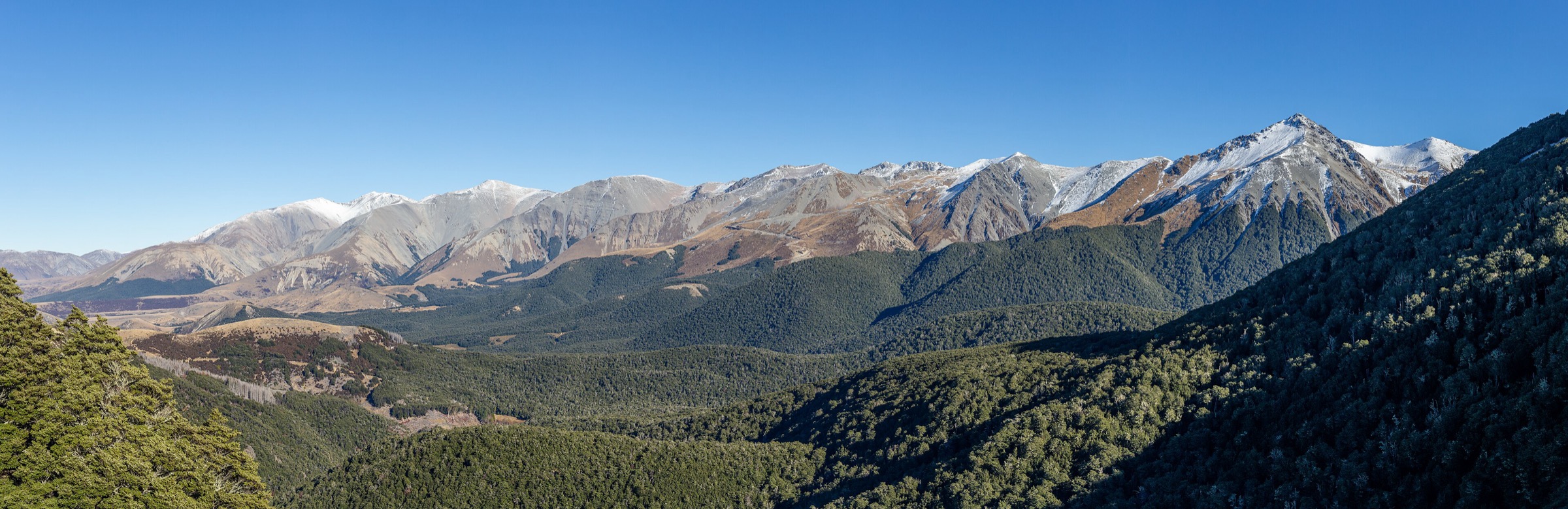
Regional overview
The Ruahine Range is the longest of the North Island axial ranges — a 110 km tussock-and-beech spine running north-east from the Manawatū Gorge to the Napier–Taihape Road, separating the Manawatū and Hawke’s Bay catchments. The northern Ruahines are the high, relatively remote northern third of the range, sitting inside Ruahine Forest Park and reached from the inland towns of Kimbolton, Apiti, Mangaweka and Taihape by a network of long gravel roads through the Rangitīkei farmland. The principal sub-ranges in this sector — the Whanahuia Range in the west, the Hikurangi Range running north toward Mangaweka (1,733 m), and the Ngamoko Range to the south — are reached by Renfrew Road above Rangiwahia, the Apiti / Petersons Road into the Oroua valley, the Kawhatau Valley and Mangakukeke roads into the Hikurangi sector, and Limestone Road for the Ngamoko tops loop.
The hiking character is classic North Island backcountry: steep beech-forest approaches climb to leatherwood, then onto exposed tussock tops with sudden weather changes. Several of the standard day routes finish at a DOC hut, with parties either turning round at the hut or pushing on to the tops as a separate objective. Three of the five entries here cross private farmland to reach the park boundary, so seasonal closures during calving and lambing, and gate paperwork, are part of every plan. The northern Ruahines are higher and more exposed than the southern end of the range — wind, cloud and rapid temperature drops are the leading hazards on the tops, more so than rock or technical ground.
Three planning issues dominate every northern Ruahine day-hike. The first is weather and exposure: DOC times assume reasonable conditions, and the open tops on the Knights-Shorts loop, the Whanahuia Range above Rangiwahia Hut and the Hikurangi tops above Purity Hut are no place to be in cloud or above-bushline wind. The second is private-land access: the Purity and Kelly Knight tracks both cross working farms and close for calving (late May to late October and into August respectively) and at the farm manager’s discretion at other times — confirm access with DOC before driving in. The third is route documentation: DOC publishes one-way times and access notes for each of these routes but does not publish standalone GPX or accurate distance/ascent figures, so the snapshot fields below reflect DOC’s stated times and flag distance and gain as unresolved where they could not be verified independently. NPS-style trail signage and reusable route files are not the norm here. DOC alerts at the Ruahine Forest Park alerts page should be checked immediately before travel.
Access is from Palmerston North Airport (PMR) or Napier (NPE) by hire car — there is no direct public transport to any of the trailheads in this catalogue, and the Renfrew Road, Petersons Road, Mangakukeke Road and Limestone Road approaches all finish on gravel that can deteriorate in wet conditions. Plan on 2–3 h of driving from Palmerston North to most trailheads, with the last 30–60 minutes on unsealed road.
Selection rationale
Five day-hikes are presented across the northern Ruahines: the Rangiwahia Hut Track as the most approachable Whanahuia Range tops walk, the Iron Gate Hut Track as the long Oroua-valley counterpoint, the Purity Hut Track as the direct climb into the Hikurangi tops, the Kelly Knight Hut Track as the Pourangaki river-sidle, and the Knights-Shorts Loop Track as the definitive Ngamoko Range tops loop. The set is built around access road and route character rather than length: two western approaches (Rangiwahia and the Oroua valley), two Kawhatau / Pourangaki farm-access routes (Purity and Kelly Knight), and the strenuous Ngamoko loop from Limestone Road.
Routes that DOC describes primarily as multi-day tramps are excluded — the Mangahuia tops traverse, the longer Pourangaki and Oroua circuits and the through-routes from Rangiwahia south to the Mangaweka tops all sit outside a day-hike catalogue. The Mangaweka summit (1,733 m) is mentioned in passing as the high point beyond Purity Hut, but is treated as a separate tops objective rather than a hut day.
Summary
| # | Hike | Trailhead | Route type | Distance | Gain | DOC time | Difficulty |
|---|---|---|---|---|---|---|---|
| 1 | Rangiwahia Hut Track | Renfrew Road, above Rangiwahia | Out-and-back | Unresolved | Unresolved | 2–3 h one way | Easy–Intermediate |
| 2 | Iron Gate Hut Track | Petersons Road, Apiti | Out-and-back | Unresolved | Unresolved | 4–5 h one way | Advanced |
| 3 | Purity Hut Track | Mangakukeke Road, Kawhatau | Out-and-back | Unresolved | Unresolved | 3–4 h one way | Advanced |
| 4 | Kelly Knight Hut Track | Kohunui Station, Mangakukeke | Out-and-back | Unresolved | Unresolved | 2 h 30 – 3 h 30 one way | Advanced |
| 5 | Knights-Shorts Loop Track | Limestone Road, Apiti | Loop | Unresolved | Unresolved | 8–10 h | Advanced |
1. Rangiwahia Hut Track

Snapshot
Itinerary
From the upper Renfrew Road car park, the track contours into red beech forest on a well-formed bench. The first kilometre passes the Deadmans Track junction, the tops route that climbs north to the Whanahuia Range proper; the Rangiwahia line continues south on the main track. After the junction the track zig-zags above an active slip section, crosses the Mangahuia Stream ravine on an arched wooden bridge (the route’s most photographed feature), and climbs through smaller subalpine shrub species past a waterfall to Rangiwahia Hut on the open Whanahuia tops. From the hut deck, the country opens north along the range. Return is by the same route, with the descent through the slip section the only sustained-attention work.
Why it is essential
Rangiwahia is the most approachable northern Ruahine tops hut, the walk most parties cut their teeth on before the harder Hikurangi or Ngamoko days. The track is well graded, historically important — the hut sits where the old Rangiwahia ski area ran in the 1950s and ’60s — and it is the most direct introduction to the red beech, waterfalls and open Whanahuia Range combination that defines the western edge of the range.
Equipment
- Walking boots or sturdy approach shoes
- Rain shell and warm mid-layer (the hut is above the bushline)
- 1.5–2 L water
- Food for the day
- Map / GPS and basic navigation backup
- Headlamp with spare batteries if starting later in the day
- Light gloves and warm hat outside summer
Hazards and notes
- An active slip section sits above the lower zig-zag — stay alert and do not stop in the slide zone.
- The ravine bridge is sound but exposed in wind; cross one at a time in strong gusts.
- The hut and immediate tops are above the bushline and can pick up snow and strong wind at any time of year — turn back if the cloud deck closes in.
- No recreational dog walking is allowed in Ruahine Forest Park.
- No cell coverage on the upper track.
2. Iron Gate Hut Track

Snapshot
Itinerary
From the Petersons Road car park, follow the formed track to the Alice Nash Memorial Heritage Lodge at the bush edge, then continue on the sidle track above the Oroua River. The route stays in the valley, repeatedly dropping into and climbing out of small side streams — the slow ground that makes the day feel longer than the map suggests. After 4–5 hours the track reaches Iron Gate Hut beside the river, a standard six-bunk DOC hut named for the iron gate at the old pack-track corridor. Return is by the same line. There is no loop variant within day-hike length.
Why it is essential
Iron Gate is the classic long northern Ruahine valley day: it connects the historic Oroua access corridor with a standard backcountry hut, and offers a serious but non-alpine objective for parties who want length and forest immersion without committing to the tops. As a contrast to the exposed Whanahuia and Hikurangi hut walks, it gives the catalogue its valley-day entry.
Equipment
- Full day-tramping kit
- Sturdy boots for the repeated side-stream work
- Rain shell, warm mid-layer
- 3 L water plus treatment for side-stream refills
- Food for a long day
- Map / GPS, headlamp with spare batteries
- Emergency shelter / PLB recommended
Hazards and notes
- The track is long for a day — start early and respect the turn-around time.
- The side-stream descents and climbs are the route’s main physical work; on wet rock the small drops are slippery.
- Slips and washed sections are common after heavy rain — check DOC alerts before driving in.
- Limited mobile coverage above the lodge; tell someone your turn-around time.
3. Purity Hut Track
Snapshot
Itinerary
From the Mangakukeke Road car park, follow the poled route across farmland through the initial flat section. At the Ruahine Forest Park boundary, the route turns up and climbs steeply through red beech and kaikawaka forest to Purity Hut in tussock above the bushline. From the hut, the Hikurangi Range tops open north toward Mangaweka (1,733 m) — that summit is a separate tops objective, not part of this hut-day entry. Return is by the same route. Engage farm permission and confirm seasonal access at DOC before driving in.
Why it is essential
Purity is the northern gateway to the Hikurangi Range and the highest country in the northern Ruahines. The walk gives fit parties a direct taste of high northern Ruahine tussock, with big central-North-Island views from the hut on a clear day — there is no comparable accessible high-tops hut day in this sector.
Equipment
- Full mountain-day kit
- Boots with good ankle support for the forest climb
- Rain shell, warm mid-layer, warm hat and gloves (tops above hut are exposed)
- 2–3 L water
- Food for a hard day
- Map / GPS, headlamp with spare batteries
- PLB recommended
Hazards and notes
- Private-land permission is required — confirm farm access with DOC and respect the 1 June – 31 October closure and any other farm-management closures.
- Livestock and electric fences on the farm section; close all gates as you find them.
- The forest climb is steep and sustained; descend with care after a long day.
- The tops above the hut catch winter snow and strong wind; turn around at the hut if conditions are marginal.
- Limited mobile coverage on the farm section, none above.
4. Kelly Knight Hut Track
Snapshot
Itinerary
From the Kohunui Station parking point, follow the markers across farmland for about 30 minutes to the Ruahine Forest Park boundary. The track then sidles above the Pourangaki River, dropping in and out of side creeks on narrow ground with steep drops to the water below. A swingbridge shortly before the hut crosses the Pourangaki — manageable for adults but difficult for small children in wind. Beyond the bridge the track reaches Kelly Knight Hut in valley forest. Return is by the same line.
Why it is essential
Kelly Knight is the accessible river-valley counterpart to Purity’s tops approach. Together the two routes frame the northern Hikurangi / Pourangaki walking character — a high-tops hut and a forested valley hut reached from the same Mangakukeke road end. As a shorter day than Purity, Kelly Knight is also the more realistic objective when the upper weather is uncertain.
Equipment
- Day-tramping kit
- Boots with good ankle support for the narrow sidles
- Rain shell, warm layer
- 2 L water plus treatment
- Food for the day
- Map / GPS, headlamp with spare batteries
Hazards and notes
- Private-land permission is required — confirm farm access with DOC and respect the calving closure (late May – late August).
- The narrow sidles above the river have steep drops; one foot wrong is a serious fall.
- Watch for slips and marked detours on the sidle sections.
- The swingbridge sways in wind and is genuinely difficult for small children.
- Limited mobile coverage; no signal once you leave the farm section.
5. Knights-Shorts Loop Track
Snapshot
Itinerary
From the Limestone Road car park, the poled route crosses farmland, then descends to Makiekie (Coal) Creek. After the crossing the track reaches the Knights / Shorts junction: take Knights Track north-east, cross the creek a second time, then climb steeply through forest and shrubland onto the Ngamoko Range tops. The route then follows the poled tops south for several kilometres — this is the section that requires the day’s stable weather, with leatherwood and tussock either side and views down both flanks on a clear day. The route descends by Shorts Track, drops back into beech forest, and joins the lower link track to return to the main junction and the Limestone Road car park.
Why it is essential
This is the definitive northern Ruahine day loop — strenuous, scenic and the cleanest single-day representation of the range’s forest-to-leatherwood-to-tussock progression. Where Rangiwahia is the introduction and Purity the tops objective, Knights-Shorts is the day that combines both characters in a single 8–10 hour loop.
Equipment
- Full mountain-day kit
- Sturdy boots for the steep forest climb
- Rain shell, warm mid-layer, warm hat and gloves
- 3 L water
- Food for a long day
- Map / GPS — the poled tops section is unmistakable in clear weather and disorienting in cloud
- Headlamp with spare batteries
- PLB strongly recommended
Hazards and notes
- The tops route is poled, not benched — in poor visibility the poles are widely spaced and easy to lose.
- Creek crossings at Makiekie can rise after rain.
- The steep forest climb on Knights Track is the day’s main physical work; pace it.
- Open tops are exposed to wind and rapid cloud change — turn back if conditions deteriorate.
- A long day, especially with daylight short outside summer; start at first light.
- No cell coverage on the tops.
Routes excluded as out of scope
The following sit inside or adjacent to the northern Ruahines but fall outside a day-hike entry, are too duplicative of the five above, or are better understood as multi-day tramps.
- Mangaweka summit (1,733 m) from Purity Hut. A separate tops objective beyond Purity, treated by DOC as a tops route rather than a hut day — out of scope as a single-day hut walk from the Mangakukeke road end.
- Mid-Pourangaki and Upper Pourangaki Hut traverses. DOC describes these as multi-day tramps; the day version to Kelly Knight is covered as entry 4.
- Oroua valley through-routes beyond Iron Gate Hut (Triangle Hut and onwards). Multi-day tramps; the day version to Iron Gate is covered as entry 2.
- Rangiwahia – Deadmans tops traverse. The Whanahuia Range traverse beyond Rangiwahia Hut is best done as an overnight, not a day-hike.
- Southern Ruahines and Whanahuia tops loops from the Kashmir / Yeoman Track end. Covered, when added, by the southern Ruahine catalogue rather than this northern entry.
External links
| Source | URL |
|---|---|
| DOC — Ruahine Forest Park | doc.govt.nz |
| DOC — Ruahine Forest Park alerts | doc.govt.nz |
| DOC — Rangiwahia Hut Track | doc.govt.nz |
| DOC — Iron Gate Hut Track | doc.govt.nz |
| DOC — Purity Hut Track | doc.govt.nz |
| DOC — Kelly Knight Hut Track | doc.govt.nz |
| DOC — Knights-Shorts Loop Track | doc.govt.nz |
| DOC — Ruahine Forest Park huts | doc.govt.nz |
| MetService — Ruahine Range forecast | metservice.com |
| Wikipedia — Ruahine Range | en.wikipedia.org |
| Wikimedia Commons — Ruahine Range category | commons.wikimedia.org |
| OpenStreetMap (ODbL 1.0) | openstreetmap.org |